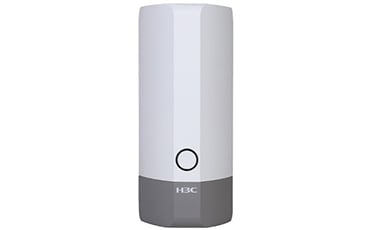
H3C WA6120X New Generation Outdoor Access Point
H3C WA6120H is a new generation Wi-Fi 6 product that complies with the 802.11ax standard.
The access point has dual-radio 4 streams and with built-in antenna, including 2x2 5GHz, and 2x2 2.4GHz, achieving speeds up to 2.975Gbps.
This access point supports both wall-mounted installation and is designed for enterprise offices, retail stores, hotels, and smart enterprise campuses that require a high-quality network experience.
Hardware specifications
Name | WA6120X | ||
Weight | 1.1Kg | ||
Dimensions (W × D × H) | 101mm X 110mm X 250mm | ||
Interface | 2 x 100/1000M Ethernet, RJ-45 | ||
PoE input | PoE injector (required) | ||
Antenna Type | Built-in omni-directional antenna | ||
Antenna Gain | 5GHz peak gain: 6dBi 2.4GHz peak gain: 4dBi Note: The equivalent antenna gain is 5dBi in 5GHz and 3dBi in 2.4GHz | ||
Frequencybands | 2.400to2.4835GHzISM 5.150to5.250GHzU-NII-1 5.250to5.350GHzU-NII-2A 5.470to5.725GHzU-NII-2C 5.725to5.850GHzU-NII-3/ISM Note: The available bands and channels are dependent on the configured regulatory domain (country) | ||
Modulation technology | OFDM: BPSK@6/9Mbps, QPSK@12/18Mbps, 16-QAM@24Mbps, 64-QAM@48/54Mbps DSSS: DBPSK@1Mbps, DQPSK@2Mbps, CCK@5.5/11Mbps | ||
Modulation mode | 11b: DSSS: CCK@5.5/11Mbps, DQPSK@2Mbps, DBPSK@1Mbps 11a/g: OFDM: 64QAM@48/54Mbps, 16QAM@24Mbps, QPSK@12/18Mbps, BPSK@6/9Mbps 11n: MIMO-OFDM: BPSK, QPSK, 16QAM, 64QAM 11ac: MIMO-OFDM: BPSK, QPSK, 16QAM, 64QAM, 256QAM 11ax: MIMO-OFDM: BPSK, QPSK, 16QAM, 64QAM, 256QAM, 1024QAM | ||
Maximum transmit power | 5GHz: 27dBm 2.4GHz: 27dBm Note: Transmit power is multi-chain combined power, no antenna gain is included. The actual transmit power depends on local laws and regulations | ||
Adjustable power granularity | 1 dBm | ||
Installation | Pole mounting/Wall mounting | ||
LED | Alternating flashing mode, yellow/green/blue for different working states | ||
Temperature | Operating temperature: -30°C to +55°C Storage temperature: –40°C to +85°C | ||
Humidity | Operating humidity: 0% to 100% (non-condensing) Storage humidity: 0% to 100% (non-condensing) | ||
Protection class | IP67 | ||
Surge | 6KV | ||
Overall power consumption | ≤16.32W | ||
Safety Standards | IEC/EN 62368-1 GB 4943.1 | ||
EMC Standards | EN 301 489-1 EN 301 489-3 EN 301 489-17 EN 60601-1-2 EN 55032 EN 55035 | CISPR 32 CISPR 35 AS/NZS CISPR32 ICES-003 Issue 7 GB/T 9254.1 GB/T 9254.2 GB 17625.1 GB 17625.2 | IEC/EN 61000-4-2 IEC/EN 61000-4-3 IEC/EN 61000-4-4 IEC/EN 61000-4-5 IEC/EN 61000-4-6 IEC/EN 61000-4-8 IEC/EN 61000-4-11 IEC/EN 61000-3-2 IEC/EN 61000-3-3 |
Radio Standards | ETSI EN 300 328 ETSI EN 301 893 ETSI EN 300 440 FCC Part 15E | ||
RoHS Standards | DIRECTIVE 2011/65/EU (EU) 2015/863 | ||
Health Standards | EN 50385:2017 EN IEC 62311:2020 | ||
MTBF (25°C) | 864581 hours |
Software specifications
WA6120X | ||
Product positioning | Basic information | Outdoor, dual-radio AP, 802.11a/b/g/n/ac/ac Wave 2/ax |
Frequency and MIMO: | 5GHz, 2×2:2, 2.4Gbps 2.4GHz, 2×2:2, 0.575Gbps | |
Compliance and bandwidth | 5GHz, 802.11a/n/ac/ax 20MHz/40MHz/80MHz 2.4GHz, 802.11b/g/n/ax 20MHz/40MHz | |
Maximum transmission speed | 2.975Gbps (2x2 80MHz on 5GHz, and 2x2 40MHz on 2.4GHz) | |
Recommended number of clients | 100 | |
Maximum number of SSIDs for each radio | 4 | |
802.11ax | MU-MIMO | Support Uplink OFDMA / Downlink OFDMA |
OFDMA | Support Uplink OFDMA / Downlink OFDMA | |
TWT | Target Wake Time, allowing clients to sleep for a predetermined period of time and be awakened only when network communication is needed, effectively reducing the power consumption | |
BSS coloring/SR | Spatial reuse, dividing different BSSs into different colors to avoid co-frequency interference and improve the user experience of wireless networks | |
WLAN basics | A-MPDU | Aggregated MAC Protocol Data Unit, Improves the data transmission efficiency of wireless networks by optimizing the composition of TX/RX directional data packets |
A-MSDU | Aggregated MAC Service Data Unit, Improves the data transmission efficiency of wireless networks by optimizing the composition of TX/RX directional data packets | |
LDPC | Low-density Parity-Check, Improves the communication efficiency of wireless networks through error correction coding technology | |
STBC | Space-Time Block Coding, Improve the Channel capacity of wireless networks through multi-antenna coding technology | |
DFS | Dynamic Frequency Selection, automatically identify DFS frequency bands, automatically adjust frequencies of the devices, and avoid interference with other devices | |
TxBF | Transmit Beamforming, Improve the signal-to-noise ratio of wireless network signal transmission by adjusting the beam direction of antenna transmitting signals | |
Tunnel management | CAPWAP tunnel | Support unicast/broadcast/DNS/DHCP/static IP method for discovering AC |
NAT | Support NAT between AC and AP | |
DTLS | Tunnel between AC and AP supports DTLS encryption | |
IPv4/IPv6 | Tunnel between AC and AP supports IPv4 and IPv6 | |
Time synchronization | Support synchronizing clock information from AC | |
Dual tunnel | Support establishing CAPWAP tunnels with two ACs | |
PPPOE | Support PPPOE Client | |
EoGRE | Fit AP mode Supports EoGRE (Ethernet over GRE), generic Routing Encapsulation, used to encapsulate and unpack Ethernet data packets | |
IPsec | Cloud AP mode Supports IPsec | |
WLAN extension | RF adjustment | Support Automatic channel/power/bandwidth adjustment |
SSID hiding | Restrict access and improve wireless network security by SSID hiding | |
Limit the number of connected users | Supports SSID/RF based | |
Forwarding mode | Centralized forwarding/local forwarding/policy forwarding Note: The AP supports centralized forwarding/policy forwarding only on the AC in Fit AP mode | |
Local forwarding | Local forwarding based on SSID and VLAN | |
VLAN bridge | Link type of a port to access, trunk, or hybrid. The port link type determines whether the port can be assigned to multiple VLANs | |
VLAN binding | Supports interface/SSID/MAC binding VLAN based | |
User isolation | VLAN-based user isolation SSID-based user isolation | |
Load balancing | Supports traffic-based load balancing | |
Supports user-based load balancing | ||
Supports frequency band-based load balancing, dual-5G devices only | ||
Band steering | Improve service quality by prioritizing access to 5G frequency bands for wireless clients | |
Roaming | Support 802.11k and 802.11v smart roaming | |
Support 802.11r fast transition roaming | ||
Multicast enhancement | Convert multicast data into unicast data for transmission, reducing network congestion | |
Wireless location | Fit AP mode supports BLE location | |
Fit AP mode supports RSSI location | ||
Mesh | Mesh link | |
Mesh link security | ||
Multi-hop Mesh | ||
Wireless probing | Monitor the wireless network environment by monitoring wireless network messages | |
Hotspot 2.0 | Fit AP mode Support Hotspot 2.0 | |
Bonjour gateway | Forwarding mDNS packets across VLANs | |
User Authentication | 802.1X authentication | Support local 802.1X authentication |
Support remote 802.1X authentication | ||
MAC authentication | Support local MAC authentication | |
Support remote MAC authentication | ||
Portal authentication | Support local Portal authentication | |
Support remote Portal authentication | ||
Support Guest/Captive portal | ||
Support portal mac-trigger | ||
Support portal escape | ||
PSK | Support PSK and Private-PSK | |
PPSK | Fit AP mode Support Private Pre-Shared Key, obtain passwords to access wireless networks through the Cloudnet platform | |
Social Media APPs Authentication | Cloud AP mode Support Google/Facebook/Twitter through the Cloudnet platform | |
Extensible Authentication Protocol (EAP) | EAP-Transport Layer Security (TLS) | |
EAP-Tunneled TLS (TTLS) | ||
Microsoft Challenge Handshake Authentication Protocol (MSCHAP) v2 | ||
Protected EAP (PEAP) v0 or EAP-MSCHAP v2 | ||
EAP-Flexible Authentication via Secure Tunneling (EAP-FAST) | ||
PEAP v1 or EAP-Generic Token Card (GTC) | ||
EAP-Subscriber Identity Module (SIM) | ||
Wireless Security | Encryption | TKIP, CCMP |
WPA2-Personal (802.11i) | ||
WPA2-Enterprise with 802.1X | ||
WPA3-Personal, WPA3-Enterprise | ||
WPA3-Enhanced Open (OWE) | ||
Advanced Encryption Standard (AES) | ||
Forwarding security | Packet filtering MAC address filtering Broadcast storm suppression | |
Wireless EAD | Coupled with EAD (End user Admission Domination) solution, implement security policies for terminals accessing the network to improve wireless network security | |
Management frame protection | Provide management frame protection for wireless clients to enhance wireless network security | |
WIPS | Wireless Intrusion Prevention System, protect the network from unauthorized access, such as Rogue AP, Rogue client, Rogue Wireless Bridge, Ad-hoc | |
Layer 2 and Layer 3 | IP address configuration | Static IP/DHCP assigned IP |
DHCP | Server/client/relay | |
NAT | NAT/NAT66 | |
LLDP | Link Layer Discovery Protocol, discovering and identifying other LLDP enabled devices and neighboring devices in the network | |
IPv4 | Supports ICMP/ACL/DHCP/TFTP/FTP/DNS | |
IPv6 | Supports ICMP/ACL/DHCP/TFTP/FTP/DNS | |
Service Assurance | Remote AP | After the tunnel between AC and AP is disconnected, AP continues to provide services to clients |
Doctor AP | Fit AP mode supports Doctor AP, simulates wireless client access process, diagnoses network issues, and improves network experience | |
Only 802.11ax accessing | Only wireless clients that support 802.11ax can access the network, improving the network experience | |
Intelligent bandwidth guarantee | Ensure that different wireless services can obtain the lowest guaranteed bandwidth during network congestion | |
Port Aggregation | Multiple uplink ports for port aggregation to increase uplink bandwidth (only applicable to multiple uplink port APs) | |
Broadcast suppression | Discard ARP request and response packets from wireless clients during the suppression cycle | |
Prohibit weak signal client access | AP prohibits wireless clients with signals below the threshold from accessing, to avoid low-signal clients occupying more channel resources | |
Terminal roaming navigation | Adjust the AP transmission power to create more roaming conditions and improve the roaming experience | |
Actively triggering client relinking | AP actively sends messages to allow wireless clients to reconnect or roam actively | |
Adjust channel reuse between APs | RF chip adjusts the environmental noise perceived by the device to improve AP transmission efficiency | |
Fast forwarding function for client data services | Intelligent optimization of RF chip business processing can improve performance | |
Shorten client sleep time | RF chips shorten client sleep time and improve transmission efficiency through beacons | |
Software version anomaly repairing | After the software version is damaged due to abnormal circumstances, AP can automatically download the available software version through AC or cloud platform | |
Service quality | WMM | Wi-Fi Multimedia, Improve the service quality of audio and video transmission in wireless networks through EDCA scheduling algorithm |
QoS | Priority Class, by marking TOS/DSCP fields to distinguish data streams with different priorities, high priority data streams can be quickly distributed, thereby improving service quality | |
Priority Class, supports mapping from wireless priority to wired priority | ||
QoS policy mapping, support QoS policy mapping based on SSID and VLAN | ||
Layer 2 to Layer 4 packet filtering and traffic classification | ||
CAR (Committed Access Rate), by limiting data transmission rate, avoid network congestion caused by traffic congestion | ||
User bandwidth management | Allocate available bandwidth per STA | |
Allocate total bandwidth for all STA shares based on SSID | ||
Dynamically adjust the available bandwidth of STA based on business | ||
CAC | Call Admission Control, improve the quality of service for wireless clients that have already received high priority by limiting the number of wireless clients that have received high priority | |
Supports number of users/Channel utilization based | ||
Application Identification | SQA (Software Quality Assurance), identifies audio and video services based on SIP protocol, prioritizing service quality assurance | |
UCC (Unified Communications and Collaboration), increase the processing priority of audio and video services and prioritize ensuring service quality | ||
Power saving | Green AP mode | Dynamically adjust MIMO configuration based on wireless client access status to reduce device power consumption |
U-APSD | Unscheduled Automatic Power Save Delivery, reduce device power consumption by scheduling VoIP data streams separately from non-VoIP data streams | |
SM Power Save | Spatial Multiplexing Power Save, reduce device power consumption through low-power standby mode | |
Management and maintenance | Centralized management | Fit AP mode, managed by AC Cloud AP mode, managed by the Cloudnet platform |
GUI | Cloud AP mode Support WEB management via HTTP/HTTPS | |
Remote debugging | Support SSH V2.0/Telnet/FTP/TFTP | |
Local debugging | Support CLI | |
Information maintenance | Cloud AP mode Support Syslog | |
Secure boot | Supporting firmware protection, ensuring the integrity of the subsequent running program codes through the trusted Boot-Loader, forming a trusted device boot chain | |
Netconf | Cloud AP mode Support Netconf provides programmable and scalable methods to manage network devices | |
IEEE standards | 802.11 | IEEE 802.11a/b/g/n/ac/ac Wave 2/ax |
IEEE 802.11d/e/h/i/w/u | ||
IEEE 802.11k/v/r | ||
802.3 | 802.3af/at | |
802.15 | 802.15.1 | |
Wi-Fi Certified | I Wi-Fi Alliance:Wi-Fi 6, WMM, WPA, WPA2 and WPA3 – Enterprise, Personal (SAE), Enhanced Open (OWE) |
