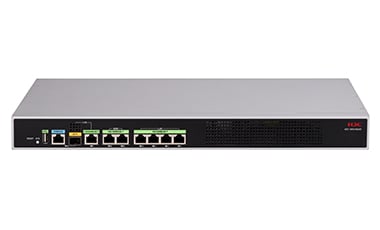
EWP-WSG1812X-PWR
H3C Wireless Integrated Services Gateway equipped with 2 × 1GE WAN ports, 12 × 1GE PoE LAN ports, and 2 × 10GE SFP+ uplink ports. The device features an integrated wireless controller with a built-in license for 32 Access Points (APs) and supports management of up to 64 APs. It combines routing, switching, PoE, and WLAN management capabilities in a single platform, enabling centralized network administration and simplified deployment. The solution is ideal for enterprise, campus, and branch office environments requiring reliable wired and wireless connectivity.
All Inclusive AP License
The WSG1840X Wireless Integrated Multi-Service Gateway includes AP license as following by default, which protects customer’s investment to maximum, which also give SMB/SME a great opportunity to add new AP with the wireless network expansion without additional cost. The number of licenses is up to 128, and 64 licenses are built-in by default. Which means WSG1840X can manage 64 ordinary AP or 128 wall-plate AP by default. Need to purchase extra license to enlarge the ordinary AP number. (Version supported since WSG1800X-CMW710-E5623)
model | AP license by default |
WSG1840X | 64 |
All-in-one Gateway
The WSG1840X Wireless Integrated Multi-Service Gateway integrates, gateway, security and AC function in one box, which is perfect for SOHO, SMB and SME environment. WSG1840X supports full enterprise controller feature sets, in addition, WSG1840X supports gateway function, such as PPPOE, NAT, dynamic IP address, and static IP address setting function.
802.11ax AP Management
In addition to 802.11a/b/g/ac AP management, the WSG1840X can work together with H3C 802.11ax based SMB APs (See ordering information for details) to provide wireless access speed several times faster than a traditional 802.11a/b/g/ac/ network.
Flexible Forwarding Modes
In a wireless network of centralized forwarding mode, all wireless traffic is sent to an AC for processing which the forwarding capability of the AC may become a bottleneck. Especially on wireless networks where APs are deployed at branches, ACs are deployed at the headquarters, and APs and ACs are connected over a WAN. In this scenario, Distributed forwarding is more suitable. The WSG1840X supports both distributed forwarding modes and centralized forwarding mode and it can set SSID based forwarding as needed.
Smart Roaming Features
Supports intra-AC roaming, cross-AC roaming, and cross-VLAN Layer 3 roaming
Portal roaming information synchronization function: AC and AP support Portal users' non-perceived roaming between ACs on a large-scale network, without the Portal mac-trigger server. The wireless controller can independently assume the mac-trigger server function. This reduces the pressure on the portal server and prevents the portal server from becoming a performance bottleneck. When the Portal server is done, the online terminal can still roam without authentication between no less than 10 wireless controllers.
802.1X roaming information synchronization function: AC and AP support 802.1X users for fast roaming between ACs on a large-scale network. Support dot1x authentication for fast roaming between ACs. Terminals do not need to do authentication again after roaming to a new AC. Alleviate server pressure and ensure fast access of terminals, and support fast roaming between more than 10 ACs.
Support 802.11k/v/r fast roaming protocols
Intelligent Channel Switching
In a WLAN, adjacent wireless APs should work in different channels to avoid channel interference. However, channels are very rare resources for a WLAN. There are a small number of non-overlapping channels for APs. For example, there are only three non-overlapping channels for the 2.4GHz network. Therefore, the key to wireless applications is how to allocate channels for APs intelligently
Meanwhile, there are many possible interference sources that can affect the normal operation of APs in a WLAN, such as rogue APs, radars and microwave ovens. The intelligent channel switching technique can ensure the allocation of an optimal channel to each AP, thereby minimizing adjacent channel interference. Besides, the real-time interference detection function can help keep APs away from interference sources such as radars and microwave ovens
Intelligent AP Load Sharing
According to IEEE 802.11, wireless clients control wireless roaming in WLANs. Usually, a wireless client chooses an AP based on the Received Signal Strength Indication (RSSI). Therefore, many clients may choose the same AP with a high RSSI. As these clients share the same wireless medium, the throughput of each client is reduced greatly.
The intelligent AP load sharing function can analyze the locations of wireless clients in real time, dynamically determine which APs at the current location can share load with one another, and implement load sharing among these APs. In addition to load sharing based on the number of online sessions, the system also supports load sharing based on the traffic of online wireless users
Support SSID automatic hiding function based on radio resource utilization. When the radio resource reaches or exceeds the configured threshold, the SSID automatically hides to provide users with stable and reliable wireless services.
Layer 4-7 Deep Packet Inspection
The WSG1840X can identify variety of applications and policy control can be implemented including priority adjustment, scheduling, blocking, and rate limiting to ensure efficient bandwidth resource and improve the network quality.
Layer 7 Wireless Intrusion Detection and Prevention Systems (WIDS / WIPS)
The WSG1840X supports the blacklist, whitelist, rogue device defense, bad packet detection, illegal user removal, upgradeable Signature MAC layer attack detection (DoS attack, Flood attack or man-in-the-middle attack) and counter measures
With the built-in knowledge base in WSG1840X, you can perform timely and accurate wireless security decisions. For determined attack sources such as rogue AP or terminals, you can perform visible physical location monitoring and switch physical port removing
With H3C firewall/IPS device, network infrastructure can also implement layer 7 security defense in wireless campus, covering wired (802.11) and wireless (802.3) secure connections on an end-to-end basis
Comprehensive Network Security Protection Capabilities
The rich feature library can complete the detection of popular viruses. It supports anti-virus to botnets, Trojans, and worms. It can identify 1500+ high-profile applications. With rich attack prevention technology, it can support both IPv4 and IPv6. It can provide effective protection against the following attacks:
1) Abnormal packet attacks (such as illegal TCP packet flags, Land, smurf, WinNuke, Ping of Death, Large ICMP Traffic/Tiny Fragment, etc.);
2) Address spoofing attacks (such as IP address attacks, port attacks, etc.);
3) Abnormal traffic attacks (such as Ack Flood, DNS Flood, Fin Flood, HTTP Flood, HTTPS Flood,ICMP Flood, ICMPV6 Flood, SYNACK Flood, SYN Flood, UDP Flood, etc.);
Security zone—Allows you to configure security zones based on interfaces and VLANs.
Packet filtering—Allows you to apply standard or advanced ACLs between security zones to filter packets based on information contained in the packets, such as UDP and TCP port numbers. You can also configure time ranges during which packet filtering will be performed.
Access control—Supports access control based on users and applications and integrates deep intrusion prevention with access control.
ASPF—Dynamically determines whether to forward or drop a packet by checking its application layer protocol information and state. ASPF supports inspecting FTP, HTTP, SMTP, RTSP, and other TCP/UDP-based application layer protocols.
AAA—Supports authentication based on RADIUS/HWTACACS+, CHAP, and PAP.
Blacklist—Supports static blacklist and dynamic blacklist.
NAT and VRF-aware NAT.
Security logs—Supports operation logs, zone pair policy matching logs, attack protection logs, DS-LITE logs, and NAT444 logs.
Routing—Supports static routing, RIP, OSPF, BGP, routing policies, and application- and URL-based policy-based routing.
Traffic monitoring, statistics, and management.
Next-generation multi-service features
Integrated link load balancing feature—Uses link state inspection and link busy detection technologies, and applies to a network egress to balance traffic among links.
Integrated SSL VPN feature—providing secure access of mobile users to the enterprise network.
Flexible and extensible, integrated and advanced DPI security
Integrated security service processing platform—Highly integrates the basic and advanced security protection measures to a security platform.
Application layer traffic identification and management.Uses the state machine and traffic exchange inspection technologies to detect traffic of P2P, IM, network game, stock, network video, and network multi-media applications. It Uses the deep inspection technology to identify P2P traffic precisely and provides multiple policies to control and manage the P2P traffic flexibly.
Categorized filtering of massive URLs—uses the local+cloud mode to provide basic URL filtering blacklist and whitelist and allows you to query the URL category filtering server on line.
Complete and updated security signature database—H3C has a senior signature database team and professional attack protection labs that can provide a precise and up-to-date signature database.
Hardware Specifications
Item | WSG1840X |
Dimensions (WxDxH) | 440*165*43.6mm |
Weight | 1.8kg |
Wireless throughput | 4Gbps |
Port | LAN:1*SFP Plus + 4*GE + 1*5GE WAN:2 GE + 1*USB |
Power supplies | 100V AC~240V AC:50/60Hz |
Operating and storage temperature | 0℃~45℃/-40℃~70℃ |
Operating and storage relative humidity | 5%~95% |
Safety Compliance | UL 60950-1 CAN/CSA C22.2 No 60950-1 IEC 60950-1 EN 60950-1/A11 AS/NZS 60950 EN 60825-1 EN 60825-2 EN60601-1-2 FDA 21 CFR Subchapter J |
EMC | ETSI EN 300 386 V1.3.3:2005 EN 55024: 1998+ A1: 2001 + A2: 2003 EN 55022 :2006 VCCI V-3:2007 ICES-003:2004 EN 61000-3-2:2000+A1:2001+A2:2005 EN 61000-3-3:1995+A1:2001+A2:2005 AS/NZS CISPR 22:2004 FCC PART 15:2005 GB 9254:1998 GB/T 17618:1998 |
MTBF | ≥50000hours |
Software specifications
Item | Feature | WSG1840X |
Basic functions | Number of managed APs by default | 64 ordinary AP or 128 wall-plate AP |
Maximum number of managed APs | 128 | |
Maximum users of authentication | 2048 | |
802.11MAC | 802.11 Protocols | √ |
The number of SSID of whole machine | 128 | |
SSID hiding | √ | |
11G protection | √ | |
11n only | √ | |
Use number limit | Supported: SSID based, per RF based | |
Keepalive | √ | |
Idle | √ | |
Multi-country code assignment | √ | |
Wireless user isolation | Supported: VLAN based wireless users 2-layer isolation SSID based wireless user 2-layer isolation | |
20MHz/40MHz auto-switch in 40MHz mode | √ | |
Local forwarding | Local forwarding based on SSID+VLAN | |
CAPWAP | Automatic AP registration | √ |
AC discovery (DHCP option43, DNS) | √ | |
IPv6 tunnel | √ | |
Clock synchronization | √ | |
Jumbo frame forwarding | √ | |
Assign basic AP network parameter through AC | Supported: Static IP, VLAN, connected AC address | |
L2/L3 connection between AP and AC | √ | |
NAT traversal between AP and AC | √ | |
Roaming | Intra-AC, Inter-AP L2 and L3 roaming | √ |
Inter-AC, Inter-AP L2 and L3 roaming | √ | |
GW Features | NAT | √ |
PPPoE | √ | |
DDNS | √ | |
SSL VPN | √ | |
IPSEC VPN | √ | |
RIP | √ | |
GRE | √ | |
Access control | Open system, Shared-Key | √ |
WEP-64/128, dynamic WEP | √ | |
WPA,WPA2,WPA3 | √ | |
TKIP | √ | |
CCMP | √(11n recommended) | |
SSH v1.5/v2.0 | √ | |
Portal authentication | Supported: Remote Authentication, external server | |
Portal page redirection | Supported: SSID based, AP Portal page push | |
Portal by-pass Proxy | √ | |
802.1x authentication | EAP-TLS, EAP-TTLS, EAP-PEAP, EAP-MD5, EAP-SIM, LEAP, EAP-FAST, EAP offload (TLS, PEAP only) | |
Local authentication | 802.1X, Portal, MAC authentication | |
LDAP authentication | 802.1X and Portal EAP-GTC and EAP-TLS supported by 802.1X login | |
AP location-based user access control | √ | |
Guest Access control | √ | |
VIP channel | √ | |
ARP attack detection | Supported: Wireless SAVI | |
SSID anti-spoofing | SSID + user name binding | |
AAA server selection based on SSID and domain | √ | |
AAA server back up | √ | |
Local AAA server for wireless user | √ | |
TACACS+ | √ | |
QoS | Priority mapping | √ |
L2-L4 packet filtering and traffic classification | √ | |
Rate limit | Supported with granularity of 8Kbps | |
802.11e/WMM | √ | |
Access control based on user profile | √ | |
Intelligent bandwidth limit (equal bandwidth share algorithm) | √ | |
Intelligent bandwidth limit (user specific) | √ | |
Intelligent bandwidth guarantee | Supported: Free flow for packets coming from every SSID When traffic is not congested, and guarantee a minimum bandwidth for each SSID when traffic is congested | |
QoS Optimization for SVP phone | √ | |
CAC(Call Admission Control) | Supported: based on user number/bandwidth | |
End-to-end QoS | √ | |
AP upload speed limit | √ | |
RF management | Country code lock | √ |
Static channel and power configuration | √ | |
Auto channel and power configuration | √ | |
Auto transmission rate adjustment | √ | |
Coverage hole detection and correction | √ | |
Load balancing | Supported: based on traffic, user & frequency (dual-frequency supported) | |
Intelligent load balancing | √ | |
AP load balancing group | Supported: auto-discovery and flexible setting | |
Security | Static blacklist | √ |
Dynamic blacklist | √ | |
White list | √ | |
Rogue AP detection | Supported: SSID based, BSSID, device OUI | |
Rouge AP countermeasure | √ | |
Flooding attack detection | √ | |
Spoof attack detection | √ | |
Weak IV attack detection | √ | |
WIPS/WIDS | Supported: 7-layer mobile security | |
Layer 2 protocol | ARP (gratuitous ARP) | √ |
802.1p | √ | |
802.1q | √ (Maximum VLANs: 4094) | |
802.1x | √ | |
IP protocol | IPv4 protocol | √ |
Native IPv6 | √ | |
IPv6 SAVI | √ | |
IPv6 Portal | √ | |
Multicast | MLD Snooping | √ |
IGMP Snooping | √ | |
Multicast group | 256 | |
Multicast to Unicast (IPv4, IPv6) | Supported: Set unicast limit based on operating environment | |
Redundancy | 1+1 failover between ACs | √ |
Intelligent AP sharing among ACs | √ | |
Remote AP | √ | |
Management and deployment | Network management | WEB, SNMP v1/v2/v3, RMON |
Network deployment | WEB, CLI, Telnet, FTP | |
Green features | Scheduled shutdown of AP RF interface | √ |
Scheduled shutdown of wireless service | √ | |
Per-packet power adjustment (PPC) | √ | |
WLAN Application | RF Ping | √ |
Remote probe analysis | √ | |
Packet forwarding fairness adjustment | √ | |
802.11n packet forwarding suppression | √ | |
Access based traffic shaping | √ | |
Co-AP channel sharing | √ | |
Co-AP channel reuse | √ | |
RF interface transmission rate adjustment algorithm | √ | |
Drop wireless packet with weak signal | √ | |
Disable user access with weak signal | √ | |
Disable multicast packet caching | √ | |
Status blink(limited to some AP) | √ | |
New added features | Policy forwarding | √ |
VLAN pool | √ | |
Bonjour gateway | √ | |
802.11w | √ | |
802.11k,v,r | √ | |
Hotspot2.0 (802.11u) | √ | |
NAT | √ | |
VPN | √ | |
Firewall | Attack protection against malicious attacks, such as land, smurf, fraggle, ping of death, teardrop, IP spoofing, IP fragmentation, ARP spoofing, reverse ARP lookup, invalid TCP flag, large ICMP packet, address/port scanning, SYN flood, ICMP flood, UDP flood, and DNS query flood | √ |
ASPF application layer packet filtering | √ | |
Basic and advanced ACLs | √ | |
Time range-based ACL | √ | |
User-based and application-based access control | √ | |
Static and dynamic blacklist function | √ | |
MAC-IP binding | √ | |
MAC-based ACL | √ | |
Antivirus | Signature-based virus detection | √ |
Manual and automatic upgrade for the signature database | √ | |
Stream-based processing | √ | |
Virus detection based on HTTP, FTP, SMTP, and POP3 | √ | |
Virus types include Backdoor, Email-Worm, IM-Worm, P2P-Worm, Trojan, AdWare, and Virus | √ | |
Virus logs and reports | √ | |
Signature-based virus detection | √ | |
Deep intrusion prevention | Prevention against common attacks such as hacker, worm/virus, Trojan, malicious code, spyware/adware, DoS/DDoS, buffer overflow, SQL injection, and IDS/IPS bypass | √ |
Attack signature categories (based on attack types and target systems) and severity levels (including high, medium, low, and notification) | √ | |
Manual and automatic upgrade for the attack signature database (TFTP and HTTP). | √ | |
P2P/IM traffic identification and control | √ | |
Email/webpage/application layer filtering | Email filtering | √ |
SMTP email address filtering | √ | |
Email subject/content/attachment filtering | √ | |
Webpage filtering | √ | |
HTTP URL/content filtering | √ | |
Java blocking | √ | |
ActiveX blocking | √ | |
SQL injection attack prevention | √ | |
VPN | L2TP VPN | √ |
IPSec VPN | √ | |
GRE VPN | √ | |
SSL VPN | √ | |
NAT | Many-to-one NAT, which maps multiple internal addresses to one public address | √ |
Many-to-many NAT, which maps multiple internal addresses to multiple public addresses | √ | |
One-to-one NAT, which maps one internal address to one public address | √ | |
NAT of both source address and destination address | √ | |
External hosts access to internal servers | √ | |
Internal address to public interface address mapping | √ | |
NAT support for DNS | √ | |
Setting effective period for NAT | √ | |
NAT ALGs for NAT ALG, including DNS, FTP, H.323, ILS, MSN, NBT, PPTP, and SIP | √ |
